The Authority Blueprint: The Five Layers Behind Strong Websites
Most websites fail for a simple reason.
Not because the design is bad. Not because the business isn’t good. Not even because the messaging is weak.
They fail because the structure behind the website was never built correctly.
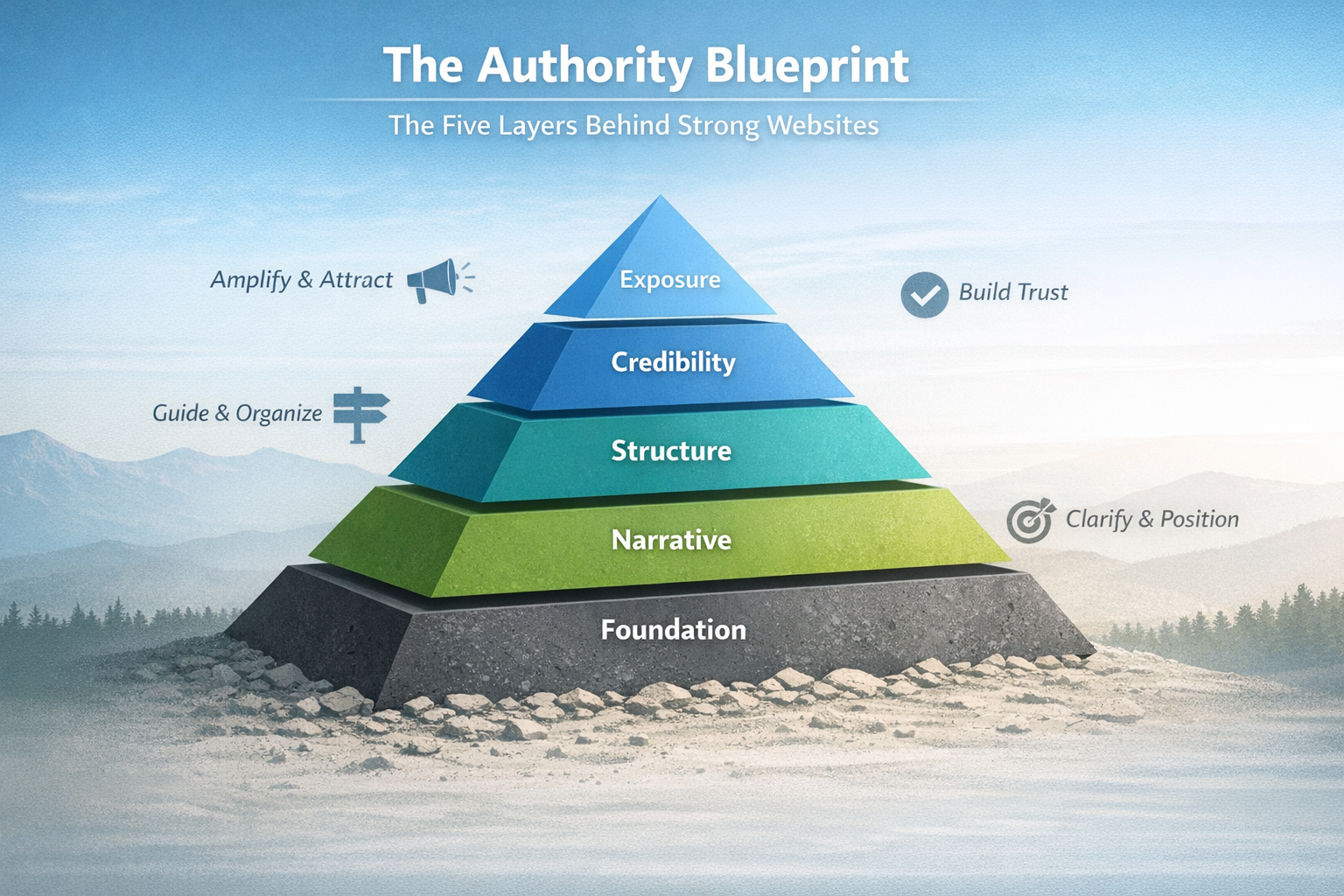
Most founders build their online presence the way people decorate a house they don’t actually own yet.
They start with:
social media
brand colors
content
marketing tactics
ads
All of which sit on top of something that was never structurally defined. And when the foundation underneath is unclear, everything built on top of it feels fragile.
Growth feels unpredictable.
Marketing feels exhausting.
Visitors arrive… but they don’t quite understand what the business actually does.
This is where the Authority Blueprint comes in.
The Authority Blueprint is a simple framework that explains why some websites quietly communicate authority the moment you land on them — while others feel confusing no matter how much traffic they get.
Strong websites are built in layers.
Not all at once.
Not randomly.
In order.
The Authority Blueprint
There are five layers behind every website that communicates real authority.
Foundation
Narrative
Structure
Credibility
Exposure
Each layer builds on the one before it.
Skip one, and the entire system weakens.
Let’s walk through them.
1. Foundation
(Positioning)
Everything starts here.
Foundation answers the most important question a website can communicate:
What is this business actually for?
This is where most websites quietly break.
Not because the founder doesn’t know what they do — but because the positioning has never been clearly articulated.
Foundation includes things like:
Who the business actually serves
The specific problem being solved
Why this business is uniquely positioned to solve it
What makes the work distinct
When foundation is clear, visitors quickly understand:
“This is for someone like me.”
When foundation is unclear, the website feels vague.
The messaging becomes broad.
The audience becomes everyone.
And when a business is for everyone, it ends up resonating with no one.
Foundation is not a tagline.
It’s the strategic clarity underneath everything else.
2. Narrative
(Messaging Hierarchy)
Once positioning is clear, the next layer is narrative.
Narrative is how the website explains the business.
Not in paragraphs.
In hierarchy.
Visitors do not read websites linearly.
They scan.
Their brain is quickly trying to understand:
What is this business?
What is the main thing they do?
What supports that main thing?
Where should I go next?
A strong narrative organizes the message into clear levels:
Primary message
Supporting message
Secondary information
Most websites flatten everything into the same level of importance.
Multiple services.
Multiple ideas.
Multiple headlines competing for attention.
When that happens, visitors don’t know what to focus on.
Narrative creates clarity of emphasis so the website feels easy to understand.
3. Structure
(Website Architecture)
Now we move to the layer most people think about first — the website itself.
But structure only works after foundation and narrative exist.
Structure answers a simple question:
Does the website guide someone toward understanding the business?
Or is it just a collection of pages?
A strong website structure creates a natural path through the business.
Visitors should be able to move through the site and gradually understand:
What the business does
Who it helps
Why the work matters
What to do next
Instead of feeling like a maze of:
Services
About pages
Blog posts
Random navigation options
Structure turns a website into something far more powerful than a brochure. It becomes a decision path.
4. Credibility
(Authority Systems)
Once the first three layers are clear, credibility begins to compound.
Credibility includes things like:
content
SEO
case studies
press
expertise
education
client results
These elements are often treated as the starting point of authority.
But credibility only works when the first layers are already clear.
Without strong foundation, narrative, and structure:
Content becomes scattered.
SEO attracts the wrong visitors.
Testimonials float around without context.
When the underlying structure is clear, credibility systems begin reinforcing the business naturally.
Visitors start to feel: This person knows what they’re doing.
And more importantly: I understand exactly what they do.
5. Exposure
(Visibility)
Exposure is the layer most people try to start with.
Social media.
Ads.
Podcasts.
Collaborations.
Email lists.
But exposure is simply an amplifier.
It multiplies whatever already exists underneath.
If the structure of the business is weak, exposure multiplies confusion.
If the structure is strong, exposure multiplies authority.
This is why some businesses grow rapidly once visibility increases — while others feel like they are constantly chasing attention without traction.
Exposure works best when the first four layers are already in place.
Why Most Websites Feel Fragile
When businesses struggle online, the instinct is usually to add more visibility.
More content.
More marketing.
More activity.
But if the underlying structure isn’t clear, growth feels unstable.
Traffic comes in… but visitors leave quickly.
Marketing works… but only temporarily.
Content is created… but it doesn’t seem to build momentum.
Because the earlier layers were skipped.
Strong websites are built from the inside out.
Foundation first.
Then narrative.
Then structure.
Everything else adds up from there.
Authority Is Structural
One of the biggest misconceptions about authority is that it comes from visibility.
But authority rarely begins with attention.
It begins with clarity.
When the structure of a business is clear, the website communicates confidence without needing to say much at all.
Visitors understand what the business does quickly.
They feel oriented.
They trust what they’re seeing.
And that trust becomes the starting point for everything else.
Evaluate Your Website Structure
If your website has grown over time, there’s a good chance parts of the structure evolved organically.
Which is completely normal.
Most founders build their website while they’re still figuring out their positioning, messaging, and services.
The Website Structure Evaluation is a short assessment designed to help you step back and look at your website through the lens of the Authority Blueprint.
It will help you quickly identify whether your website currently reflects:
clear positioning
strong messaging hierarchy
intentional site architecture
credibility systems that reinforce the business
Or whether some of the earlier layers need strengthening.
Take the Website Structure Evaluation →
Because the strongest websites aren’t just beautifully designed. They’re structurally clear.